
Face masks create a significant barrier to communication for people with hearing loss, reducing auditory clarity by up to 20 decibels and hiding crucial visual cues like lip movements and facial expressions. The solution requires a two-part approach: people with hearing impairment can use assistive listening devices, smartphone amplification apps, and clear communication strategies, while those speaking to them should optimize their speech techniques, use transparent masks when appropriate, and create better listening environments.
The challenge became widespread during recent public health measures, but the communication barriers masks create extend far beyond temporary circumstances. Whether you wear hearing aids or simply find it harder to follow conversations when people cover their faces, understanding why masks interfere with hearing helps you identify the right solutions.
Your ears rely on more than sound alone. Researchers estimate that up to 60% of speech understanding comes from visual information, especially in noisy environments. When a mask covers someone’s mouth, you lose access to lip reading, facial expressions, and the natural amplification that occurs when sound travels directly toward you. The fabric itself muffles high-frequency sounds, exactly the frequencies that carry consonants and speech clarity.
This isn’t about your hearing getting worse. The difficulty you experience is a genuine acoustic and visual barrier that affects everyone, though it impacts those with existing hearing challenges most severely.
How Face Masks Affect Sound and Communication
Face masks create a triple barrier that makes hearing significantly harder. They physically muffle sound, alter the frequencies we rely on most for understanding speech, and block the visual information many people use without even realizing it.
When someone speaks through a mask, their voice travels through multiple layers of fabric before reaching your ears. This material absorbs and scatters sound waves, reducing volume by 4 to 12 decibels depending on the mask type. That might not sound like much, but it’s enough to turn clear speech into something that requires real effort to understand. Surgical masks cause less muffling than cloth masks, while N95 respirators create the most significant barrier.
The problem goes beyond simple volume reduction. Masks particularly dampen high-frequency sounds, the very frequencies that carry consonants like “s,” “f,” and “th.” These consonants help us distinguish between similar words, think “sat” versus “fat” or “think” versus “sink.” When masks muffle these sounds, words start blending together, forcing your brain to work overtime filling in the gaps.
Research on the effects of masks on speech confirms what many people experience firsthand: understanding drops noticeably when the speaker wears a mask, especially in noisy environments where your brain already struggles to separate speech from background sounds.
But perhaps the most underestimated challenge is visual. Most of us lip-read to some degree, even with perfect hearing. Studies show that up to 60% of speech understanding comes from watching a speaker’s mouth, facial expressions, and gestures. Concealing lip-reading cues behind a mask removes this crucial support system.
Masks impact hearing through several mechanisms:
- Sound attenuation reducing speech volume by 4-12 decibels
- Blocked access to lip movements and mouth shapes
- Muffled high-frequency consonant sounds essential for word clarity
- Hidden facial expressions that normally provide context and emotional cues
For people with hearing loss who already work harder to understand speech, these combined effects can make routine conversations feel exhausting or impossible. Your hearing aids can amplify sound, but they can’t restore the visual information masks hide or fully compensate for distorted speech signals.

The Double Challenge: Masks and Hearing Aids
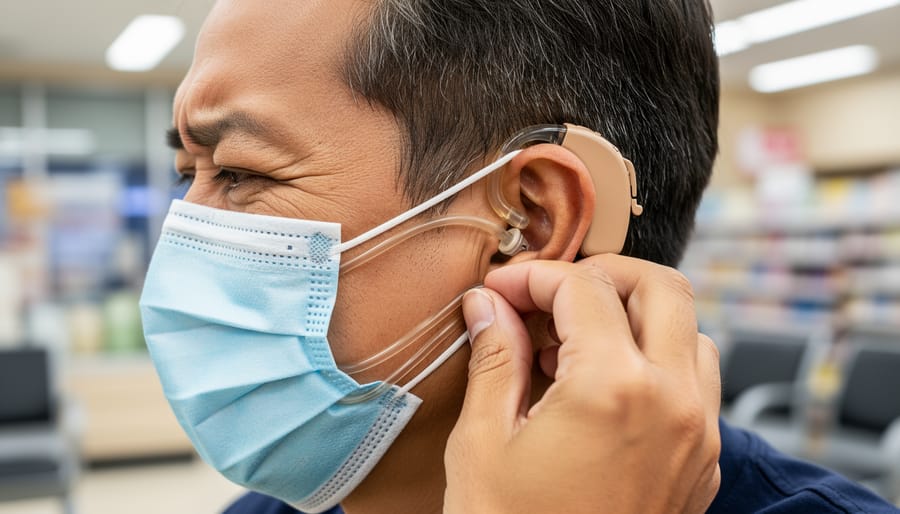
If you wear behind-the-ear hearing aids, you’ve likely discovered that elastic mask loops compete for the same real estate. Every time you remove your mask, those loops can catch the body of your hearing aid and send it tumbling to the floor. This isn’t just frustrating; it’s a real risk. Hearing aids are precision devices, and a hard fall onto tile or pavement can damage delicate internal components or crack the casing.
The problem gets worse when mask straps sit too close to the microphone opening. This proximity can create feedback, that high-pitched whistle you hear when something blocks or reflects sound back into the aid. Even without feedback, the constant friction between elastic and plastic generates its own rustling noise, which your hearing aid dutifully amplifies. What should help you hear ends up broadcasting the sound of fabric rubbing against your ear.
Then there’s the fit issue. Mask loops pull hearing aids forward and away from their optimal position behind your ear. When an aid shifts even slightly, it may not seal properly, reducing effectiveness and increasing the chance it’ll work loose entirely. Some users find that ear loops cause issues with proper device placement throughout the day, requiring constant readjustment.
Completely-in-canal aids avoid the strap tangle, but they don’t escape all mask-related problems. The increased sound muffling from masks affects all hearing aid users equally, and the loss of visual cues hits everyone trying to follow conversation. If you’re already adjusting your aids multiple times daily or noticing more whistling since mask-wearing became routine, you’re experiencing a widespread challenge that has practical solutions.
Practical Solutions for Better Communication While Masked
For People with Hearing Loss
If you have hearing loss, there are concrete steps you can take to improve communication when masks are necessary.
Start by being direct about your needs. Don’t hesitate to tell people you have hearing difficulty and ask them to face you directly when speaking. Most people want to help but may not realize masks make communication harder for you. A simple “I have hearing loss and masks make it tough for me to hear, could you please face me and speak clearly?” sets clear expectations.
Control your environment when possible. Position yourself so background noise is behind you rather than between you and the speaker. In healthcare settings or shops, request to move somewhere quieter if the current space is too noisy. Stand about three to six feet away, close enough to hear clearly but far enough that you’re both comfortable.
Adjust your hearing aids for mask situations. If you wear hearing aids, talk to your audiologist about programming adjustments that reduce rustling sounds from masks while amplifying speech frequencies. Many modern devices let you fine-tune hearing aids through smartphone apps, allowing you to switch to settings optimized for mask-wearing situations.
Carry backup communication tools. Keep your phone handy for typing messages when spoken communication fails. Some people find it helpful to carry a small notepad for quick exchanges. These aren’t admissions of defeat, they’re practical solutions that keep conversations flowing when masks create too much of a barrier.
For Family, Friends, and Healthcare Providers
If you’re communicating with someone who has hearing loss, your awareness and adjustments make an enormous difference when masks are involved. Start by getting their attention before speaking, a gentle wave or light touch on the shoulder ensures they’re ready to listen. Position yourself so they can see you clearly, ideally in good lighting with minimal background noise.
Speak clearly and at a moderate pace, but don’t shout. Raising your voice distorts sound and actually makes understanding harder. Instead, focus on enunciating words and pausing slightly between sentences. If someone doesn’t understand, rephrase rather than simply repeating, sometimes different words click better.
Face the person directly while speaking. Even with a mask obscuring your mouth, body language and facial expressions around the eyes communicate meaning. Avoid turning away mid-sentence or covering the mask with your hand, which further muffles sound.
In healthcare settings particularly, check understanding by asking patients to repeat back key information rather than just nodding. Write down critical details like appointment times, medication names, or dosages. Many people with hearing loss hesitate to ask for repetition multiple times, so create an environment where questions are genuinely welcomed.
Control the environment when possible. Turn off background music, close doors to noisy hallways, and move conversations away from air vents or machinery. These adjustments benefit everyone but are essential for someone working harder to hear through a mask.
Your patience matters profoundly. Communication may take longer, and that’s perfectly acceptable. Showing willingness to slow down and ensure understanding demonstrates respect and builds trust, making difficult conversations manageable even when masks are necessary.

Mask Alternatives and Accessibility Options
Several mask alternatives designed specifically for accessibility have emerged, offering solutions that balance safety with the communication needs of people with hearing loss. These options prioritize visibility while maintaining protective function, though each comes with trade-offs worth considering for your specific situation.
Clear masks feature a transparent plastic panel over the mouth area, allowing full visibility of lips, teeth, and facial expressions. These masks maintain the visual cues essential for lip reading while providing a physical barrier. Window masks work similarly but typically have a smaller transparent section rather than a fully clear front. Both types enable the communication strategies that hearing aid users rely on beyond just amplified sound.
- Allow complete lip reading and facial expression visibility
- Reduce the muffled sound effect of standard cloth masks
- Help maintain natural communication flow in conversations
- Signal to others that you prioritize accessible communication
- Fog up easily, especially with temperature changes or breathing patterns
- Often more expensive than standard cloth or disposable masks
- May feel less comfortable due to rigid plastic components
- Not as widely available in all retail settings
When selecting an accessible mask, consider your primary environments. Healthcare settings, where communication precision matters most, often accommodate or even provide clear masks upon request. For everyday use, anti-fog treatments and proper fit adjustments can minimize the fogging issue that plagues many clear mask designs. Look for masks with adjustable ear loops rather than rigid bands, as these work better with behind-the-ear hearing aids and create a better fit and sound experience overall.
Some workplaces and public facilities now stock clear masks specifically for interactions with people who have hearing loss. Don’t hesitate to ask whether accessible options are available, or to bring your own. Many hearing aid users keep a clear mask on hand to offer conversation partners, turning a potential barrier into an opportunity for better mutual understanding.
Technology That Helps Bridge the Gap
Modern hearing technology offers several features designed to cut through the communication fog that masks create. If you already wear hearing aids, chances are you have tools at your fingertips you might not be fully using.
Directional microphones focus on sound from in front of you while reducing noise from other directions. When someone’s wearing a mask, activating this feature helps your devices zero in on their voice rather than ambient sounds. Many hearing aids let you adjust this through buttons on the device or a smartphone app.
Speaking of smartphones, Bluetooth connectivity transforms your phone into a powerful communication aid. You can stream phone calls directly to your hearing aids, bypassing mask muffling entirely. Video calls with captions become clearer, and you can use your phone’s microphone positioned near the speaker while listening through your aids.
Remote microphone systems take this concept further. A small wireless microphone clips to a speaker’s clothing, transmitting their voice directly to your hearing aids. This technology proves invaluable in medical appointments or group settings where masks are required.
Don’t overlook maintenance basics. Masks can jostle devices, potentially dislodging components, so remember to change hearing aid domes regularly for optimal sound quality.
Captioning apps like, Live Transcribe, or Ava provide real-time text transcription of conversations. While not perfect, they offer a written backup when auditory understanding falters. Some work offline, making them reliable in any setting.
Your hearing care professional can help you explore which features your current devices support and recommend upgrades if your technology predates these innovations. The right combination of tools can dramatically improve masked communication.
When to Seek Professional Support
If you’re finding that masks have made everyday conversations frustrating or exhausting, it might be time to book a hearing assessment. Many people first notice hearing difficulties when face coverings remove the visual cues they’d been unconsciously relying on for years. Struggling to understand masked speech doesn’t always mean the mask is the only problem, it can signal underlying hearing loss that deserves attention.
A hearing care professional can evaluate your specific challenges and recommend solutions tailored to your lifestyle. Whether you need your first hearing aids or adjustments to your existing devices, hearing aid personalization makes a significant difference in real-world situations like masked conversations. Features such as speech-in-noise programs, directional microphones optimized for your listening environments, and connectivity options can be fine-tuned to address exactly what you’re experiencing.
Don’t wait until communication becomes unbearable. Independent audiologists can provide unbiased advice about which technologies and strategies will genuinely help you, without pushing products you don’t need. They’ll also teach you how to maximize your hearing aids’ capabilities in challenging situations, including when visual cues aren’t available.
If masks have shown you how much you’ve been missing, that’s valuable information, and professional support can help you reconnect with the conversations that matter.
Masks have undeniably made communication harder for people with hearing loss, but you’re not without options. From clear masks and strategic positioning to hearing aid adjustments and assistive technology, the solutions outlined in this article can help you stay connected despite the barriers.
Don’t hesitate to speak up about your needs. Whether you’re asking someone to face you directly, requesting a quieter space, or exploring new hearing aid features, advocating for yourself matters. If you’ve noticed your hearing struggles have worsened since masks became common, that’s a signal worth paying attention to.
Consider scheduling an appointment with a hearing care professional who can assess your situation and recommend personalized solutions. Sometimes what feels like a mask problem reveals an underlying hearing challenge that deserves attention. With the right strategies and support, you can maintain the conversations and connections that matter most to you.