
Two-crossover is a sophisticated frequency management feature in modern hearing aids that splits incoming sound into two separate frequency bands for independent processing. The technology divides sound at a specific crossover point, allowing your hearing aid to apply different amplification strategies to low and high frequencies simultaneously based on your unique hearing profile.
This matters because hearing loss rarely affects all frequencies equally. You might need more support in high frequencies where speech clarity lives while requiring less amplification in the lows where background noise often hides. A two-crossover system gives your hearing aid the flexibility to target your specific needs across the sound spectrum instead of treating all frequencies the same way.
The concept becomes especially important when you’re struggling to hear conversations in noisy environments or finding that some voices come through clearly while others remain muffled. Two-crossover processing helps explain why today’s hearing aids can sound so much more natural than older models, even though the basic idea of amplification hasn’t changed.
This article walks you through exactly how two-crossover technology functions inside your hearing aids, the different ways audiologists configure it, and what it means for your day-to-day hearing experience. You’ll understand the mechanics without needing an engineering degree, see how it compares to simpler and more complex systems, and learn what questions to ask your hearing care professional about whether this feature matches your hearing loss pattern and lifestyle needs.
What 2 Crossover Means in Hearing Aid Technology
In hearing aid technology, a 2 crossover system splits incoming sound into two separate frequency channels, one handling low-pitched sounds and another managing high-pitched sounds. Think of it as dividing the audio spectrum at a carefully chosen point, typically between 1000 and 2000 Hz, so each range can receive the precise amplification and processing it needs.
This approach matters because your hearing loss probably isn’t uniform across all pitches. Most people with hearing loss struggle more with high frequencies, where consonants like ‘s’, ‘f’, and ‘th’ live, while their low-frequency hearing remains relatively strong. A 2 crossover system recognizes this reality. Rather than amplifying everything equally, it can boost those critical high frequencies for speech clarity while applying less amplification to lower frequencies where you might not need it.
- Crossover frequency
- The specific pitch point, measured in Hertz (Hz), where the hearing aid divides sound into separate channels for processing. In 2 crossover systems, this typically falls between 1000-2000 Hz.
- Frequency channels
- Distinct sound ranges that receive independent processing within the hearing aid. A 2 crossover system creates two channels: one for bass and midrange sounds, another for treble and high-pitched sounds.
- Signal processing
- The hearing aid’s manipulation of sound after it’s captured by the microphone, including amplification adjustments, noise reduction, and frequency-specific treatment before output to your ear.
- Acoustic range
- The complete span of sound frequencies humans can hear, from deep rumbles around 20 Hz to high-pitched whistles near 20,000 Hz, though hearing loss typically affects portions of this range differently.
The real-world payoff shows up in noisy restaurants or crowded rooms. Background noise, dishes clattering, air conditioning hum, general crowd murmur, tends to concentrate in lower frequencies. Speech clarity, especially those hard-to-catch consonants, lives in the higher range. By processing these separately, a 2 crossover system can suppress distracting low-frequency rumble while ensuring you catch the details that make conversations intelligible. You’re not just hearing more sound; you’re hearing the right sounds amplified appropriately for understanding.
How 2 Crossover Works in Your Hearing Aid
The Role of Crossover Frequency
The crossover frequency is the precise point, measured in hertz, where your hearing aid divides incoming sound into low and high channels. Most 2 crossover systems set this split between 1000 and 2000 Hz, though the exact frequency depends entirely on your unique hearing profile.
Your audiologist selects this crossover point by analyzing your audiogram, which maps your hearing ability across different frequencies. Someone with significant high-frequency hearing loss might need a lower crossover point (around 1000 Hz) to capture more speech consonants in the enhanced high channel. Conversely, if your hearing loss affects mainly the upper ranges, a higher crossover frequency (closer to 2000 Hz) might preserve more natural low-frequency perception while targeting problem areas.
Modern hearing aids offer considerable flexibility here. During your fitting appointment, your audiologist can adjust the crossover frequency and observe how the change affects your speech understanding in real time. If your initial setting doesn’t feel right after a few weeks of wear, they can shift the crossover point up or down and modify the amplification in each resulting channel. This customization ensures the technology serves your specific hearing needs rather than applying a one-size-fits-all approach.
Signal Processing in Each Channel
In a 2 crossover hearing aid, once sound splits into separate channels, each receives customized treatment that targets your specific hearing needs.
The low-frequency channel handles bass sounds, things like traffic rumble, air conditioning hum, and the deeper tones in voices. For many people with hearing loss, low frequencies remain relatively intact. Your hearing aid processes these sounds carefully, often applying less amplification to prevent them from drowning out more important speech sounds. Some devices even compress or reduce excessive low-frequency noise that would otherwise mask conversations.
The high-frequency channel manages the sharper sounds where most speech clarity lives. Consonants like “s,” “f,” “th,” and “sh” all exist in higher frequencies, and these are exactly the sounds people with hearing loss typically struggle to hear. Without these consonants, words blur together, “sat” sounds like “at,” and “fish” becomes “ish.” Your hearing aid applies stronger, more precise amplification to this channel, restoring those missing pieces of speech.
This separate treatment matters because your hearing loss pattern is unique. You might need significant help with high frequencies while low frequencies remain comfortable. A single-channel system would either over-amplify low sounds (creating discomfort) or under-amplify high sounds (leaving speech unclear). The 2 crossover design solves this problem by giving each frequency range the exact amplification it needs, creating clearer, more natural sound quality tailored to your hearing profile.
Types of Crossover Systems in Modern Hearing Aids
Modern hearing aids use different crossover configurations to match varying degrees and patterns of hearing loss. Understanding these options helps you have more informed conversations with your audiologist about what suits your needs.
A 2 crossover system splits sound into two frequency bands, low and high, with a single dividing point. This approach works well for people with mild to moderate hearing loss, particularly when high frequencies need more amplification than low frequencies. The simpler design uses less battery power and processes sound quickly, which many wearers find comfortable for everyday conversations and television listening.
A 3 crossover system adds a middle frequency band, creating three separate processing channels. This finer division helps when hearing loss affects different frequency ranges unevenly. The extra channel gives your audiologist more control to match your specific hearing pattern, though it requires more processing power and a slightly larger battery.
Multi-band processing goes further, dividing sound into anywhere from four to twenty or more frequency channels. The latest hearing tech often features these sophisticated systems, which excel in complex listening situations like crowded restaurants or outdoor gatherings. More channels allow extremely precise adjustments, but they also cost more and demand greater computing resources.
Your audiologist chooses a crossover configuration based on several factors: your hearing test results, the environments where you struggle most, your lifestyle needs, and your comfort with technology. Someone with a straightforward high-frequency loss might thrive with a 2 crossover system, while severe or irregular hearing loss patterns often benefit from additional channels. The goal is not necessarily the most channels, but the right match for your hearing and daily life.
When 2 Crossover Technology Helps Most

Two crossover technology delivers the most noticeable improvements in everyday situations where speech clarity matters most. If you struggle to follow conversations when background noise competes for attention, the separate handling of low and high frequencies can make a meaningful difference.
Common scenarios where two crossover systems excel include:
- Restaurant conversations where you need to hear voices over clinking dishes and background chatter
- Family gatherings with multiple people talking simultaneously
- Watching television without cranking up the volume to uncomfortable levels
- Phone calls where consonant sounds determine whether you catch critical details
- Shopping trips or waiting rooms with ambient noise and distant voices
- Outdoor settings where wind noise can obscure speech
The technology proves particularly helpful for people with mild to moderate high-frequency hearing loss, the most common pattern audiologists see. When you lose sensitivity to higher pitches first, consonants like ‘s’, ‘f’, ‘th’, and ‘sh’ become harder to distinguish. These sounds carry the meaning that separates “fish” from “fist” or “cat” from “cap.” Two crossover processing amplifies these critical high frequencies more aggressively while managing lower rumbling sounds separately, so speech cuts through background noise more clearly.
You might also notice benefits with hearing with masks or understanding speakers at a distance, where visual cues don’t help as much. That said, hearing needs vary considerably from person to person. Your audiologist will assess your specific hearing profile, lifestyle demands, and listening environments to determine whether two crossover technology matches your requirements or whether a different approach would serve you better.
How Independent Audiologists Customize 2 Crossover for You
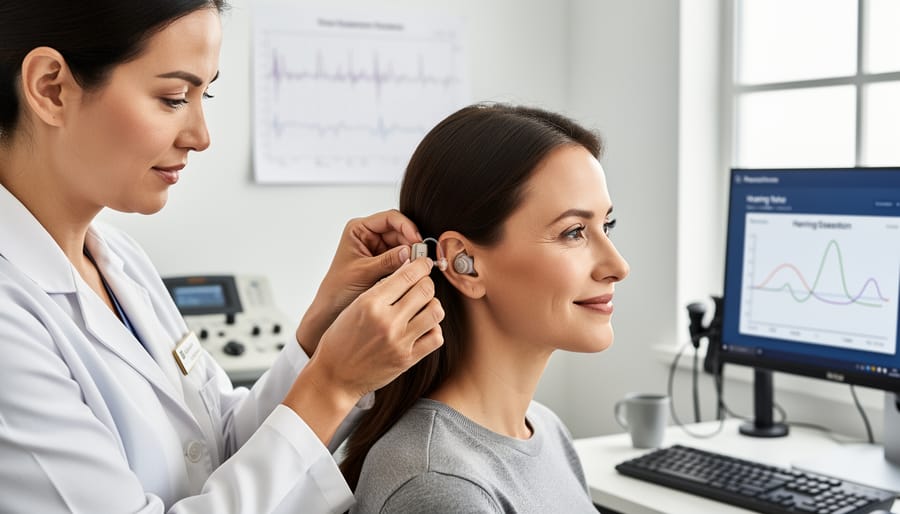
Getting the most from 2 crossover technology depends entirely on professional programming tailored to your hearing. An independent audiologist doesn’t just fit a device, they customize every parameter based on your unique hearing loss pattern and lifestyle needs.
The process starts with comprehensive hearing tests that map your specific frequency losses. Your audiologist uses these results to select the optimal crossover point, determining exactly where to split low and high frequencies for your ears. Someone with steep high-frequency loss needs a different crossover setting than someone with gradual decline across frequencies.
Real-ear measurement follows fitting. Your audiologist places a tiny microphone in your ear canal while you wear the hearing aid, verifying that programmed settings actually deliver the intended sound levels at your eardrum. This objective data ensures the crossover is working as designed for your ear anatomy.
Then comes real-world testing. You’ll try the hearing aids in various situations and report back on what works and what feels off. Your audiologist adjusts the crossover point, amplification levels in each channel, and other parameters based on your feedback. This is where personalization matters most, independent experts take time for multiple adjustment appointments until you’re satisfied.
Unlike retail settings focused on sales quotas, independent audiologists build long-term relationships. They’re available for seasonal adjustments, technology updates, and addressing new hearing challenges as they arise. Your crossover settings can evolve with your needs.
Common Questions About 2 Crossover Technology
Most people wonder whether crossover technology is something they’ll actively notice or whether it works invisibly in the background. These questions come up frequently during hearing aid consultations, and understanding the answers helps you make informed decisions about your hearing care.
Will I notice the crossover working?
You won’t hear the crossover switching or feel any change in operation. Instead, you’ll experience the result, clearer speech and more comfortable sound quality, especially in challenging environments.
Can the crossover point be adjusted later?
Yes, your audiologist can modify the crossover frequency during follow-up appointments as your needs change or if your initial settings need refinement based on real-world use.
Is 2 crossover better than single-channel processing?
Generally yes, because it allows different frequency ranges to be treated independently. Single-channel systems apply the same processing to all sounds, which can amplify background noise along with speech.
Do all modern hearing aids use crossover technology?
Most current devices use some form of frequency splitting, though the number of channels varies. Basic models might have fewer divisions, while premium devices offer multi-band processing with more precise control.
If your hearing aids aren’t delivering the clarity you expected, the crossover settings might need adjustment rather than the device not working properly. The difference between 2 crossover and more advanced multi-channel systems comes down to precision and complexity. While 2 crossover splits sound into low and high frequencies, multi-band systems divide the spectrum into numerous smaller segments for extremely fine-tuned processing. For many people with mild to moderate hearing loss, 2 crossover provides excellent results without the added complexity and cost of premium multi-channel technology. Your audiologist can help determine which level of processing matches your hearing profile and lifestyle needs.
Understanding how 2 crossover works puts you in a stronger position when choosing hearing aids. This technology isn’t just a technical feature, it directly impacts your ability to follow conversations at family dinners, hear dialogue clearly while watching films, and participate comfortably in social gatherings. The practical benefits show up in the moments that matter most.
The journey from professional audio engineering to hearing healthcare demonstrates how crossover learning advances the field. Techniques developed for recording studios and concert halls now help millions hear better every day. Your hearing aids contain decades of refined sound science, adapted specifically for speech clarity and listening comfort.
Your next step is a conversation with an independent audiologist who can assess whether 2 crossover technology suits your hearing loss pattern. They’ll measure your specific frequency needs, set the optimal crossover point, and adjust the system as your hearing changes. You’re not navigating this alone, expert guidance ensures the technology works for you, not the other way around.
The right hearing solution is within reach, combining proven technology with personalized professional care. You deserve hearing aids that fit your life, and 2 crossover technology offers a reliable foundation for better hearing.